
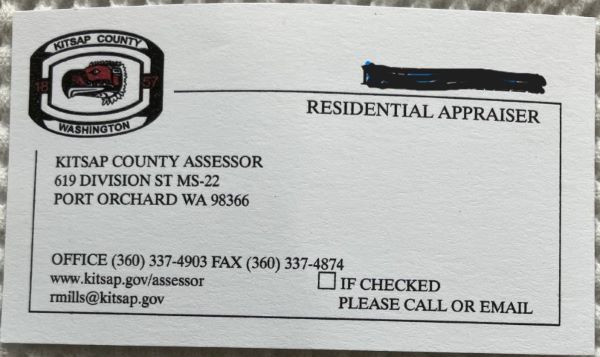
Homes on Mud Bay and Rocky Point are currently undergoing appraisal inspections. By law this is required every six years. Yesterday, a residential appraiser from the Kitsap County Assessor’s office rang my doorbell, handed me his card (see scan), and explained the process. His inspection will help set my home’s assessed value as of January 2027, which will be the basis for property taxes collected in 2028.
So, if the last appraisal inspection was done in 2020, either I wasn’t home or don’t remember it. That’s not surprising as the appraiser doesn’t need access to your home; the inspection is done from the outside.
During our conversation I asked the appraiser if he needed anything from me. His only question was whether the home has some deferred maintenance items. I told him no other than needing new windows. Will that help lower the appraisal? Probably not.
I should have asked the appraiser to come back on Thursday morning when the highest November King Tide hits and it’s apparent that flooding with be a big concern in another decade or two.
According to the assessor’s website, my home’s value hasn’t changed since 2022. Between 2020 and 2022, it had two big increases totaling ~37 percent. Since then, Kitsap County has used the 2022 value each year in calculating my property taxes, which, unfortunately, haven’t stayed the same, although the recent annual increases have been less than the rate of inflation.
I’m predicting a large increase in assessed value in 2027 for two reasons: (1) there was a big increase after the last appraisal inspection six years ago and (2) the assessed value has stayed the same for 5 years even as home prices have skyrocketed. The question is how much the increase will affect my property taxes in 2028.
Even a big increase in assessed value doesn’t necessarily result in an eye-popping hike in property taxes. Nor is the converse true. That’s because changes in taxes for individual properties vary, depending on that property’s change in value compared with others in the district. Throw in increases that come from voter-approved levies and what doesn’t seem to happen is individual property tax bills that only go up by the 1 percent state law allows local districts to increase their budgets.
The system used to calculate property taxes is complex. I think politicians and tax collectors want it that way. Still, I would rather pay high(er) property taxes than have the income threshold subject to the new millionaires tax lowered in a future session of the state legislature.

