
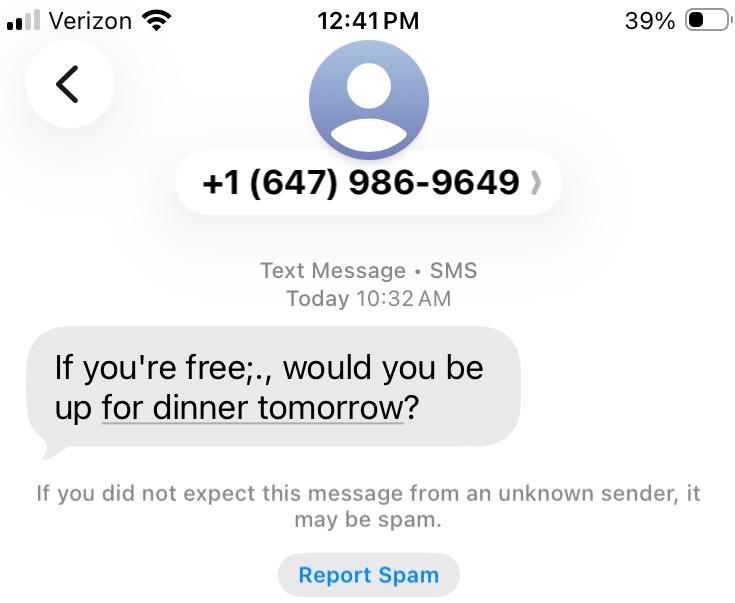
My response is always the same when I get a text on my iPhone like the one shown in the screen capture — delete the message and be glad I don’t receive more of them. This time, with nothing pressing to do, I examined the message a bit more closely and considered its mission. Still, the result was the same. I’m not having dinner with 1-647-986-9649.
First I looked at the wording of the text. “If you’re free” is a good way to start with someone like me. I’m almost always free. “[W]ould you be up for dinner tomorrow?” is another good choice. I never miss dinner, free or not. Adding in “;.,” following “If you’re free” doesn’t build confidence though as it isn’t something a normal human would do. Why not go for a punctuation grand slam and throw in a colon as well?
Next I checked the spam reminder that accompanied the message. It’s easy to understand although the reminder includes the word “may” as a careful hedge. There’s also a Report Spam button. Generally, I don’t tap links like it because spam continues to thrive no matter what we do. My real question is how the message sender (spammer?) hoped to succeed given that Verizon easily identified the spam and helpfully included a warning.
Finally I wondered what the spammer actually wants from me. I’m a great first date, but somehow I don’t think this is about having dinner. Instead I’m guessing that the intent was to see if the message went to an active phone that belongs to someone who will reply to strangers quickly even if the response is “stop” or “wrong number.” Do that and you move into a higher-value category that could be targeted with more sophisticated scams involving identify theft or bank fraud. And those won’t include an offer to have dinner.
I deleted the message with no action taken. Looks like I’m on my own tomorrow night.

