Category Archives: Other Local Places
Bungalow Brown
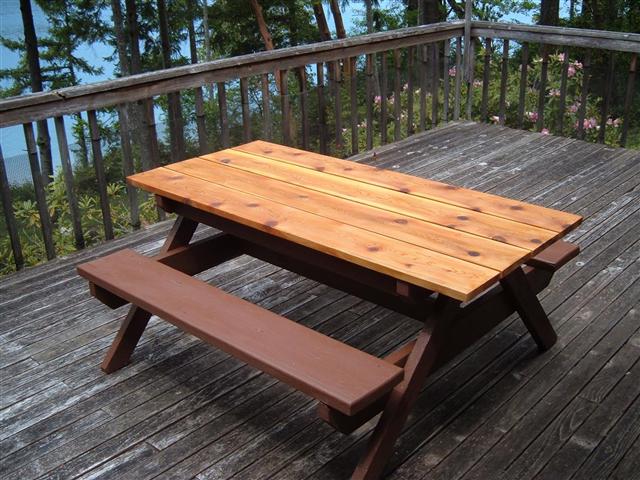
Bungalow Brown. That’s the color I used when I recently repainted the picnic table K’s dad made for us about 20 years ago. He died in 1994, but I think if he were still around he would be happy with the job. Sporting a new cedar top and fresh paint (see photo), the old table is ready for the coming summer.
Continue reading
Scotch Broom Bloom
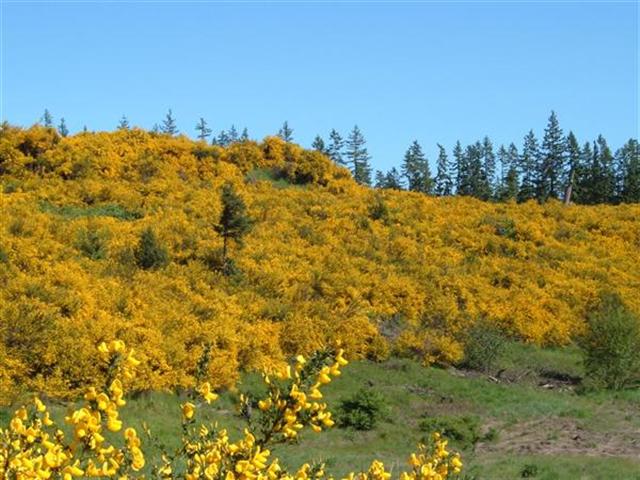
This time of year you really notice how prevalent Scotch broom (Cytisus scoparius) is along Western Washington’s county roads and rural highways (see photo). The invasive species is in full mustard-colored bloom everywhere and lines State Route 3 almost continuously from Bremerton to Belfair. The land bordering Route 3 has been logged extensively. Scotch broom thrives in the resulting sunny open areas.
For a plant with no friends, it’s probably not the best strategy to be so easy to spot. Not that the aggressive shrub is worried—once the roots are established it can be as tough to eradicate as kudzu. I’m just glad I’m not prone to pollen-borne allergies.
Buoy Collection Envy—Take Two
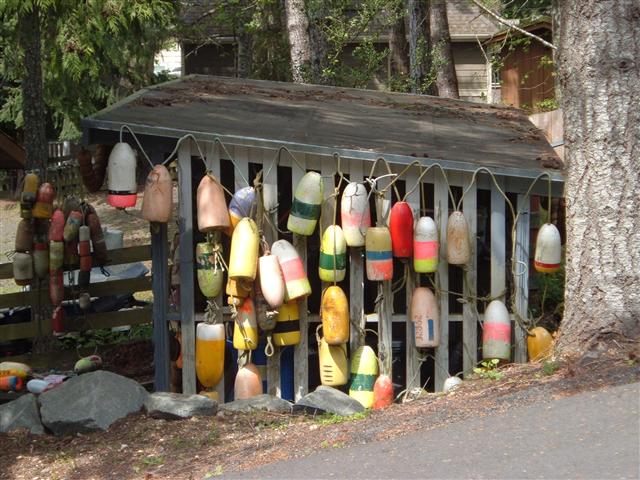
A previous post about fishing buoys compared my small collection with a colorful display mounted on the side of a shed on Cape Cod. Turns out I don’t need to go that far to find a collection to aspire to. The owner of the buoys shown in the photo lives on North Bay across from Allyn.
I wonder if most of the buoys on the shed came from local waters. If so that might explain why I never find any strays when I’m boating around Treasure Island. Clearly I’m up against a pro.
There’s one more photo after the jump.
Continue reading
Permission Granted
For the past few weeks I have been calling and sending email to get permission to use an old Bob Seger song as the soundtrack for a video tribute for the Treasure Island bridge. Today permission was granted. Although I almost gave up several times, now I can move on to the hard part—finishing up a slideshow that honors the bridge and respects Mr. Seger, not that he will ever see it.
Continue reading
A Thousand Icicles
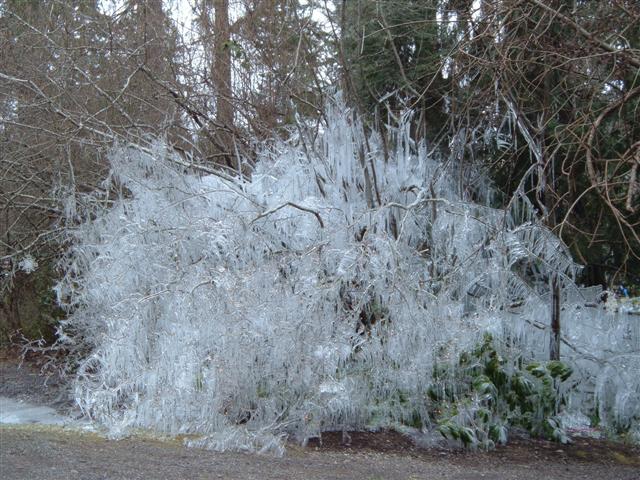
The weather has been frigid the last few days with daytime highs in the thirties and lows in the teens at night. A few days ago most of Puget Sound was on an extended snow watch with some areas getting up to six inches of snow. Even so I was surprised to see an icicle tree on my bike ride today (see photo). The winter wonder is on Hood Canal’s North Shore Road about a half mile west of Belfair State Park.
The family who lives there usually decorates the trees along the road at Christmas time with lights and hanging snowflakes (a few are visible under the ice). For this late February display they seem to be going for the spiky frozen look. I don’t know if they sprayed the tree with a hose or perhaps a sprinkler head broke and supplied the water. Either way the icicles are real (brr) but probably not natural. The green layer under the frozen branches is a mixture of rhododendrons and sword ferns, leaves heavily encased in ice.
Halloween Stores
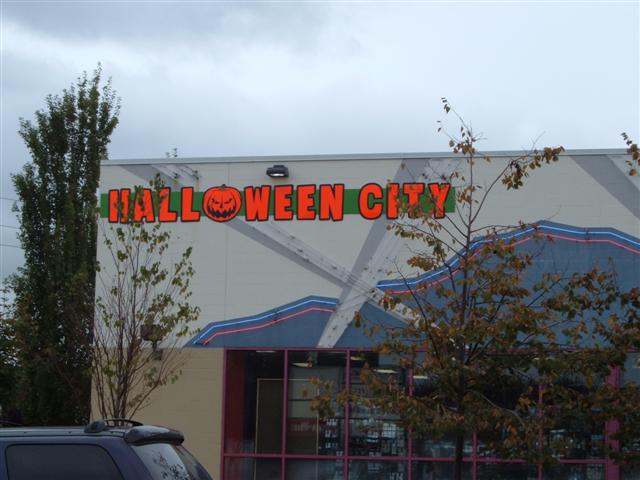
Americans are expected to spend $5.8 billion on Halloween this year. That’s a lot of retail. Until yesterday, however, I wasn’t aware that there are seasonal stores (see photo) dedicated solely to supplying us with the perfect costumes, accessories, and decorations for Halloween.
Continue reading
Coming in Spring 2010/11
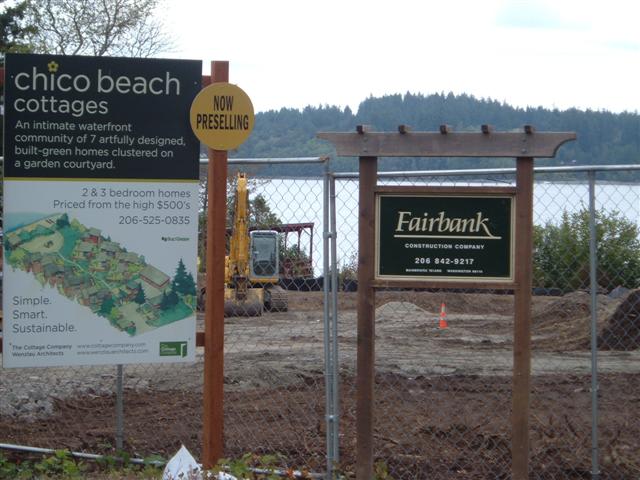
The old sign announcing the Chico Beach Cottages said something like “Coming in Spring 2010” or “Available in Spring 2010.” Construction finally started a couple of weeks ago. The new sign (see photo) doesn’t mention the missed deadline, but a flyer available at the site states that completion is now targeted for Spring 2011. It also advises that only 5 of the 7 homes to be clustered on the roughly 1-acre site, which are priced from the mid-$500s, are left. I learned this on my bike ride today.
The waterfront project is located on the northwest side of Dyes Inlet, just before Chico Way dead ends into Newberry Hill Road, about a half-mile south of Silverdale. It’s a high-rent area due to the view and location. The home just to the north of the project is valued at more than $760,000 on the county tax rolls. I will miss the heavily wooded lot that’s been clear cut to make room for the cottages. But it will be interesting to see if the project can live up to its own marketing: “Once in-a-lifetime opportunity to own a new, legacy waterfront home in Kitsap’s first ‘pocket neighborhood’ cottage community!” More important whether the long-delayed construction start means local real estate professionals think Central Kitsap is emerging from the housing slump.
Driving in Bremerton
It’s the first of September, the first day of the fall school term in Bremerton. That’s one more reason to be careful when driving around town. The safety of kids is of course paramount, but that’s not what I’m writing about. With red-light cameras at major intersections and a citywide emphasis on traffic enforcement, drivers already need to be especially vigilant when driving in Bremerton. The all-day 20-mph speed limit in school zones just ups the chances of getting a traffic citation.
Continue reading
Fishing Sculptures
Can anything new be said about the controversial public art (see photo) that was installed this month at the intersection of Fourth and Pacific in downtown Bremerton? The sculptures, of a fish and a fisherman, have been criticized in blog entries, in letters to the editor, and in hundreds of online comments on the Kitsap Sun web site. The answer is probably no, but that didn’t stop me from writing about them.
Continue reading
Wild Rhododendrons
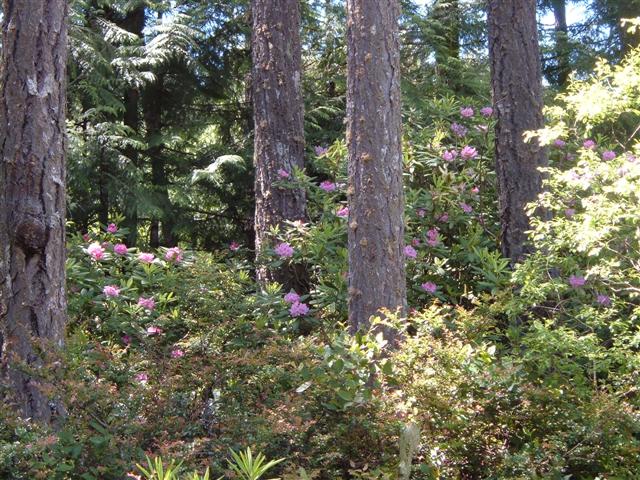
It’s the end of May and coast rhododendrons, Washington’s state flower (Rhododendron macrophyllum), are in full bloom, showing off their attractive pink blossoms (see photo). Perhaps I should refer to them as “native” instead of “wild” rhododendrons, although one web site I consulted said they were imported from California rather than originating in the Evergreen State. Whichever modifier is used, they do quite well without any help from man. No one fertilizes them, prunes the old blossoms, or waters them during our hot dry summers.
Coast rhododendrons are found west of the Cascade Mountains growing naturally along the edges of forests and in clear-cuts and natural clearings. They thrive at sea level but can survive at elevations up to 4000 feet. Woodland areas near the Hood Canal are a particularly good place to see them. At maturity the plants are 6 to 8 feet high, but they can reach heights of 20 feet. With hundreds of varieties of rhododendrons available at nurseries, landscapers seldom use coast rhododendrons to decorate homes and commercial property. That’s fine with me, as I prefer to see them in their natural setting.