Category Archives: Mud Bay & Rocky Point

Mud Bay Walk

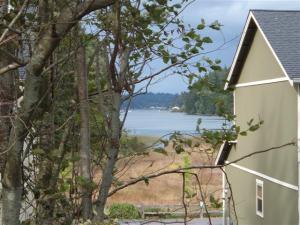
South End at High Tide

South End at High Tide


This morning I did something I haven’t done since I first moved to Rocky Point Road in the late 1970’s. After putting on my oldest shoes and waiting for low tide, I slogged my way along the shore to Mud Bay’s south end to see the wetlands there. The photo above shows the wetlands at high tide as seen looking north from Kelly Road. A split-rail fence, punctuated every 50 feet or so with a sign saying “Wetland Buffer Boundary,” marks their southern end. The fence parallels an access road added in 2007 when several houses were built adjacent to the wetlands.

I wanted to see the wetlands from the Mud Bay side and, short of trespassing through someone’s yard, the only way to get there was by hiking from my house (about half a mile). There’s no trail to speak of. To avoid sinking into the ankle-deep mud I stayed close to the shore, although low-growing Madrona and Douglas fir branches provided frequent obstacles. I followed what appeared to be a raccoon highway; their prints were everywhere. The Mud Bay basin flattens out at the south end, terminating in several acres of wetlands covered mainly by a mixture of pickleweed and a type of marsh grass. To my untrained eye the area seems undamaged from the new houses close by. After watching a great heron work the mudflats in search of breakfast, I hiked back and hosed off.
Issues in the Rocky Point Water District

The first question on the survey handed out at the town hall meeting held September 16 at Crown Hill School asked if I even knew there was a Rocky Point Water District (before that night). I did, but just about everything else said at the meeting, including the issues we are facing, was news to me. So I’m glad I attended and applaud the three elected commissioners (Gil Knutzen, Bhaskar Deodhar, and David Rhine) for holding it. My estimate is that around 10 percent of the RPWD customers attended. One mistake on my part: I should have eaten dinner before the 6:30 PM start.
Continue reading

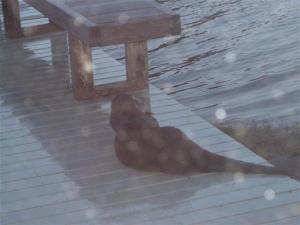
Otter on Deck

Otter view

Otter view


Mud Bay is a body of salt water. Washington state has a large population of sea otters (around 1000 by one estimate). So the otter that sacked out on my deck one winter morning last year (see photo) was a sea otter, right? Wrong. “What you had was a river otter,” said my cousin J.A., retired curator of marine mammals at Sea World in San Diego. His wife, a former animal trainer at Sea World and the San Diego Zoo, agreed. The clincher was the otter’s choice for a napping place. Members of the weasel family, both river otters (Lontra canadensis) and sea otters (Enhydra lutris) move about easily in an aquatic environment, but only the river otter is equally versatile on land. It would be extremely difficult for a sea otter to haul itself up on my deck. Sort of like the difference between a seal and a sea lion.

The name “river otter” is a bit of a misnomer. I can’t improve on Wikipedia’s helpful attempt to clear up the confusion: “Although commonly called a ‘river otter,’ the name can be misleading, as the animals inhabit marine as well as freshwater environments.” While most river otters I have seen have been the size of house cats, this one does fit in the upper end of the size range for its species (11 to 30 pounds and up to 42 inches in length). Had it been a sea otter, it would have been a small one, as males range from 49 to 99 pounds and females weigh between 30 and 73 pounds. After a brief rest the otter moved on, possibly to hunt for fish, mollusks, or crustaceans in Dyes Inlet. From my safe vantage point inside the house, the sleek visitor didn’t appear to have missed too many meals.

Rocky Point’s Private Roads

Private Road Sign

Private Road Sign

There are five marked private roads in the 2-mile stretch from where Rocky Point Road angles off from Marine Drive to its dead end on a high bluff overlooking Dyes Inlet. That doesn’t include the dozen city and county roads it also spawns. While 17 cross streets may seem ample for pinpointing addresses in the area, many of the numerous unmarked shared driveways along Rocky Point Road might also qualify for (and perhaps benefit from) private road status.
Continue reading

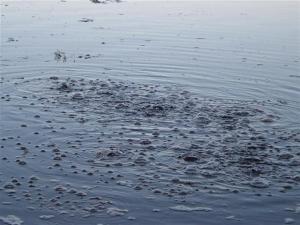
Mud Bay’s Mysterious Bubbles

Double, double toile and trouble

Double, double toile and trouble; Fire burn, and cauldron bubble.


My sister first noticed the Mud Bay bubbles (see photo) during a visit a couple of years ago to see my new house. Since then she keeps asking “Have you found out what causes them?” When conditions are right – high tide and calm water – an area maybe 40 yards out from shore seethes like the cauldron tended by Macbeth’s witches (OK, an exaggeration but you get the idea). And apparently this has been going on for years, at least according to the former owner of my house. “It’s just air bubbling to the surface,” he said. Sure. But why there and what causes it to be released?
Continue reading

MUDDBAY

I Can't Spell

I Can't Spell

I ordered a set of personalized license plates for my pickup truck a couple of years ago right after I bought the house on Mud Bay. Not surprisingly MUDBAY was taken (it’s registered to the Bremerton owner of a silver Mercedes). I learned this from browsing a database of vanity plates on the Tacoma News Tribune web site. What did surprise me was that MUDBAY2, 3, and 4 were also gone—to a family living on Lopez Island. Nor was MUD-BAY available. So I settled for a spelling-challenged version (see photo).
Continue reading

1958 Pontiac

1958 Pontiac Catalina

1958 Pontiac Catalina

It’s spring, the weather last Sunday was great, April starts tomorrow. Definitely time to start thinking about collector cars. I’m hoping for another glimpse soon of the gorgeous black 1958 Pontiac two-door I first saw at Silverdale Transmission a few years ago. Since then there have been enough sightings of the black beauty on Rocky Point Road to conclude that it lives nearby. I have looked for it a few times on my bike rides, but given Rocky Point’s many long driveways and steep terrain, I haven’t had any luck so far. Plus common sense says the pristine Pontiac is tucked away safely inside a garage, making the task that much harder. Even my friend Willy, who seems to know just about everyone in the neighborhood, can’t help me find it.
Continue reading

A Connection to Trails End Lake

A horrific crime that occurred in late February at Trails End Lake in Mason County has a connection to Mud Bay. The story received extensive coverage in the Kitsap Sun and on Seattle TV stations. To summarize, a 46-year-old man beat a woman severely in her home with a chair and cane. Although she was bound with duct tape and bloody, she managed to escape and run to a neighbor’s house. The neighbors called 911 and sheltered the woman until sheriff’s deputies and medics arrived. Her injuries were serious enough to require an airlift to Harborview Medical Center in Seattle. The Kitsap Sun described the neighbors, the Goldbergs, as true heroes for opening their home to the woman so she could escape her attacker. The man returned to her home, where he died in a fire he set after a standoff with a sheriff’s SWAT team.
Continue reading

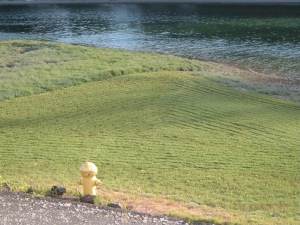
Pickleweed

Just Mowed Pickleweed

Just Mowed Pickleweed

Pickleweed (Salicornia virginica) is the dominant plant growing along the shore at the mouth of Mud Bay. A low-growing succulent, pickleweed is found in the intertidal zone, meaning it is completely under water some of the time. Thus pickleweed is classified as a halophyte, a type of plant specially adapted for life in salt water. When the roots take up salt water, the plant’s cells filter out the salt and move it to the tips of the leaves. This process allows the roots and stem to remain salt-free and to grow new leaves when the old ones cannot hold any more salt and die.
Continue reading

A Great Tides Web Site

If you notice the tides a lot like I do, there are instances when you want to know the official times and measurements for the day’s tides. It’s not enough to look out the window and think “that’s a really high tide” or “looks like at least a minus two.” Of course it is easy enough to buy a tides booklet like Dot’s Fishing Guide at a hardware or sporting-goods store. But Dot’s is limited in the number of tides tables it includes and they always seem to require both a time and measurement correction for your location.

Years ago I stumbled on a great online resource for nationwide information on tides. For my state alone (Washington), it lists 166 locations, including one close enough to Mud Bay that no corrections are needed: Tracyton Dyes Inlet. The web site is easy to use and has never been offline when I have tried it. You can get the tides (and moon data) for up to 14 days at time—present, past, or future. If you need a longer interval, copy and paste the first fortnight into your word processor, change the start date, and click “Get Tides” again. Kudos to the good folks who provide this useful web site:

www.saltwatertides.com