
The insulation upgrade to my 50-year-old house was completed on January 6th. So far, I don’t have enough data to know if I’m going to save significantly on heating costs. This week’s cold weather would be a great test of whether the upgrade is making the house more comfortable except there’s no good way to measure that.
The impetus for taking a serious look at my home’s energy efficiency was simple: during a cold snap in February 2025 my gas furnace stopped working. I tried to get by with space heaters (bad idea) and long underwear for a couple of weeks while I was deciding whether to repair it, replace it, or switch to a heat pump. In the end, I had it repaired.
As part of my research on energy use, 2Z Energy (Milton, Washington) did an energy audit. That was money well spent although it came with a few surprises. I was expecting the auditor to tell me to concentrate first on replacing the windows and sliding glass doors, which are old and don’t fit well. Instead, the most important recommended improvements were to seal and insulate the heating ducts, install a vapor barrier in the crawl space, and bring the insulation in both attics and the crawl space up to current “R” standards. My gas company, Cascade Natural Gas (CNG), offers rebates covering those items.
To qualify, the work needs to be done by a CNG preferred contractor (called a trade ally). The owner of the first local trade ally I contacted (R&R Insulation, Seabeck, Washington) sold me with his professionalism and thoroughness. I didn’t bother with any other estimates. The work was done in early January, and the cost was well into five figures. This was too late for any federal tax credits as they expired at the end of 2024.
However, the CNG rebates will cover about 45 percent of the cost. One thing CNG doesn’t tell you is how long it takes to get the rebates. You pay your contractor right away, but CNG doesn’t reimburse you for two to three months. (I’m still waiting for a rebate check.) Of course, your decision shouldn’t be based solely on rebates. Primarily, the expenditure should benefit your situation, although helping combat climate change is a plus. That’s even if the savings contributed by a single house is extremely small.
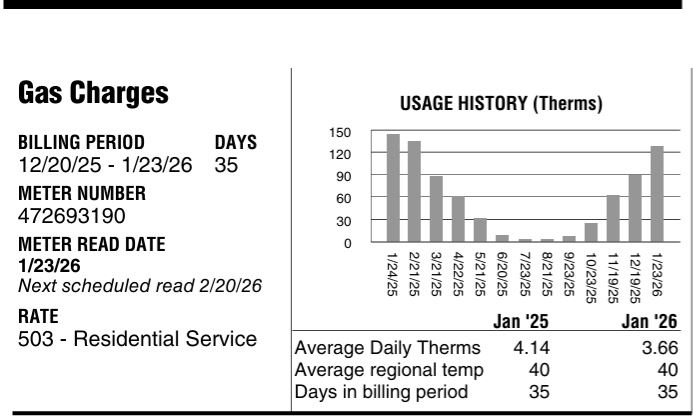
My January 2026 natural gas bill (see screen capture) is encouraging but hardly conclusive as only about half of the billing period occurred after the insulation upgrade. The number to look at is average daily therms. These dropped from 4.14 in January 2025 to 3.66 this year (12 percent) even while the average daily temperature (40 degrees) didn’t change. You can’t just compare the overall bill amounts (although January 2026 was lower than January 2026) because natural gas prices have gone up since last year. I should know more when I get the February bill.
Absent numerical data, it would be great to have other measures of energy efficiency improvements. Does the house seem more comfortable, does it take less time to get to the desired temperature? I live here and can’t really tell. In fact, unless you live in a barn, the most important factor affecting comfort in your home is where you set the thermostat not energy efficiency. Speaking of that, this week’s cold snap (mid-40’s daytime, low 30’s nighttime, and a possibility of snow) is making the furnace work. But it likely would have been working even harder a year ago. That is, until the inducer motor failed and kicked off the insulation upgrade process.
 Mud Bay Blog