
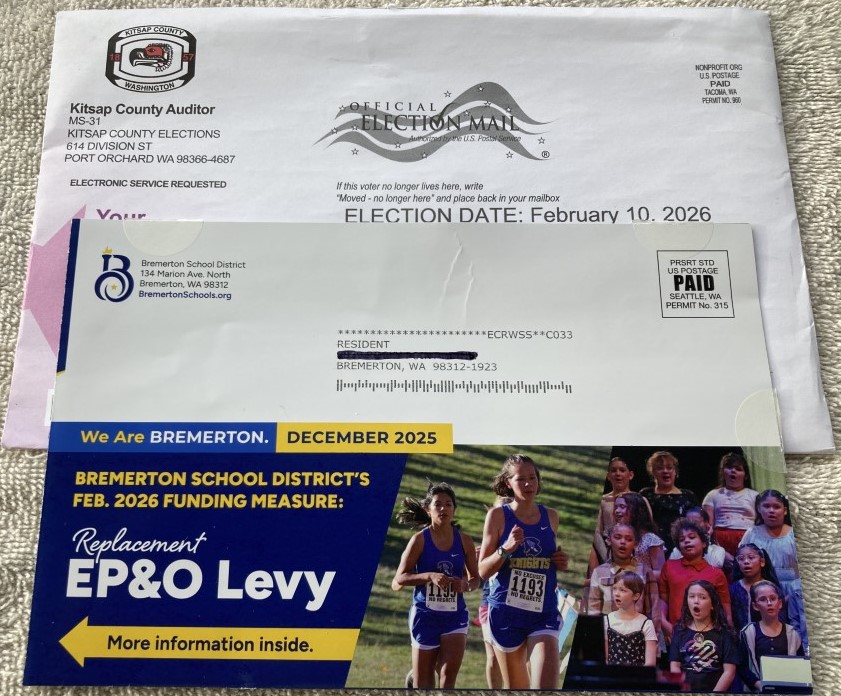
Last week the school levy ballot and the Bremerton School District’s justification for passing it (see photo) arrived in the mail. It’s not the increase in property taxes I’m objecting to as I will be voting “yes.” Rather, having lived in Bremerton since the 1970’s, I have seen this movie before many times and I’m bored with it.
Everything about the levy points to a process that’s been perfected over time: organization, timing, amount of ask, justification. The process is so well organized that it’s almost futile for voters to try to oppose it. If the levy doesn’t pass, the Bremerton School District (BSD) will keep running it, using taxpayer money, until it does. Boring.
This particular levy is an Educational Programs and Operations (EP&O) levy (as opposed to a construction bonds levy). Operations levies need a simple majority to pass and almost never fail in Bremerton with the last few winning approval in the 60 to 65 percent range. There’s no reason to think the results will be any different this time. Boring.
The last day of voting is February 10th, just a few days before the 2026 Kitsap County property tax statements are mailed out. Coincidence? Not likely. With nothing else on the ballot, voter turnout will be lower, making February the ideal time to ask for a property tax increase. The BSD timed the mailing of its December 2025 newsletter, which features a justification for the levy, to coincide with the receipt of the levy ballot. Finally, a letter from BSD Superintendent Dr. Slade McSheehy, asking for voter support, ran in the Kitsap Sun last week. The Super Bowl-bound Seattle Seahawks couldn’t run a better choreographed play than the levy team. Practice makes perfect. Boring.
The levy ask is for $71.7 million in property taxes over four years (2027 to 2030). Voter pamphlet materials stress that the levy is a renewal of an existing levy with a small increase (around 4 percent) this time. The increase, a tad above the inflation rate, seems designed to keep things moving forward without seeming greedy. Boring. Of course, if your property goes up in value more than the average property does in the BSD during the collection years, your levy share will too.
With a population of about 49,500, the levy ask works out to about $1450 for every person (adults and kids) in the district over four years. While property tax is paid by property owners, in most cases it is passed on to renters. Thus, most of the money would be spent on other things if there were no levy. But even that idea isn’t new. Boring.
The justification for local school-operations levies is that Washington does not fully fund the actual cost of providing students with a safe and quality education. As just a couple of examples, the levy will pay for 89 percent of the safety and security staff and 75 percent of the technology staff. Overall, it will fund about 15 percent of the BSD’s operating budget. This despite a clause in Washington’s constitution that explicitly declares that education is the state’s paramount duty. Washington has had more than 10 years to fully implement the McCleary decision, which directed the state in 2012 to meet its constitutional obligation to fully fund basic education. McCleary’s result was big pay increases for teachers (good for them) and a slight detour in the levy process for a couple of years. But by now we are back to the same old local levies. Boring.
Boring as they are, there is a plus to having periodic school levies. Before voting, some voters take the time to review how their local schools are performing.
Gotta go. My ballot awaits.
 Mud Bay Blog