
Like many (mostly older?) Americans I’m bummed that penny production ended this month. Just because pennies cost several times their value to make doesn’t mean the United States should stop minting them. Lost in the coverage of this issue in both mainstream and social media is what Victor D. Brenner, the Lincoln wheat penny designer, might say if he were still around.
If you think there’s mismanagement in our current government, consider penny production in 1909. As the year started, the U.S. mint continued to make Indian Head pennies, including a scant 309,000 “S” pennies in San Francisco, the lowest run of the 50-year Indian Head series. This was followed by the Lincoln penny, which honored our 16th president on the centennial of his birth and featured Lincoln’s bust on the obverse and twin wheat sheaves on the reverse. The coins were minted in Philadelphia (no mint mark) and San Francisco (“S” mint mark directly under the date).
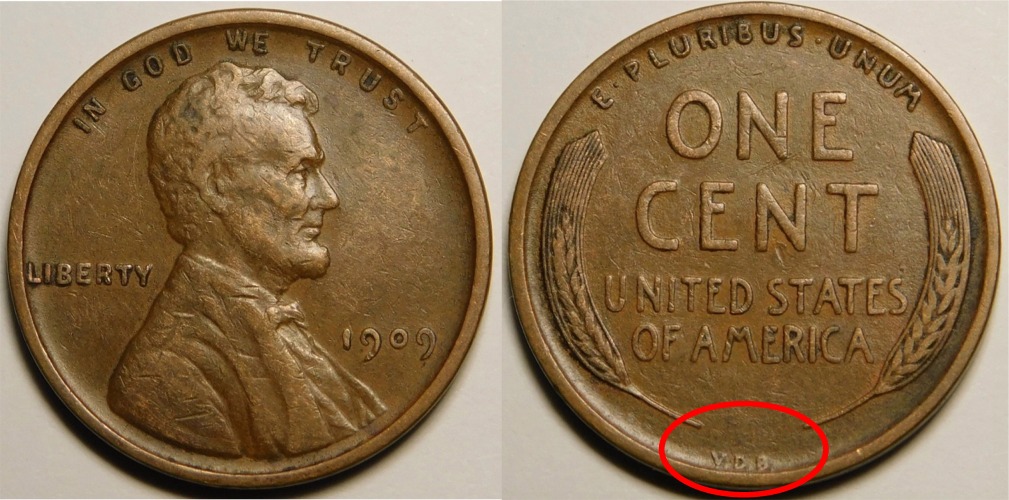
The new Lincoln pennies ran into controversy right away, the complaint being that Brenner’s initials, located at the bottom of the reverse or wheat-sheave side (see photo), were too prominent and resulted in free advertising for the designer. The initials were removed but not before a brief run of only 484,000 were produced in San Francisco. By contrast about 1.8 million 1909 “S” pennies were made in San Francisco after the initials were removed. Production figures in Philadelphia for 1909 were higher: 28 million VDB pennies, 72.7 million without initials.
Thus a total of 6 penny designs exist for 1909. While the 1909-S Indian Head penny is scarcer, the 1909-S VDB Lincoln penny is more valuable. That’s because more people collect Lincoln pennies, and as the lowest mintage Lincoln penny ever (unless you count mint errors), it is the hardest one to find. Both coins are examples of government-created scarcity at its worst.
So what would Victor D. Brenner say now given that the penny has been canceled? We can’t know for sure because he died in 1924. Assuming he’s over the snub of having his initials removed, he might be proud that his design (for the coin’s obverse anyway) lasted for 116 years.
He might also say that the reverse didn’t need a redesign in 1959 when the wheat sheaves were replaced by the Lincoln Memorial or that the more recent changes to the reverse—four designs minted for Lincoln’s bicentennial in 2009 and the Union Shield cent in 2010—were also unnecessary.
For the record, Brenner’s initials were restored in 1918 although they were added subtly and you have to know where to look. For best results, get a newer penny without much wear and check Lincoln’s shoulder. I use a lighted magnifying glass, but they can be seen unaided.
Ending penny production is projected to save about $56 million each year. Brenner might applaud that based on the government budgets of his time. However, given the size of today’s annual deficits, it’s little more than a rounding error.
 Mud Bay Blog