
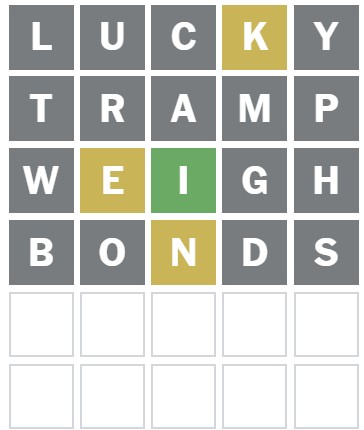
You can try to solve the daily Wordle puzzle in as few guesses as possible or you can adopt a game plan where the goal is to solve the puzzle period. My Wordle strategy is mainly concerned with getting the right answer. Today’s game (see screen capture) is a good example.
Wordle was created by a software engineer named Josh Wardle. The challenge is to guess a five-letter word within six attempts. Each entry you make must be a valid word. The puzzle shows you if the letters you enter are in the word, in the word in the correct spot, or not in the word. After six tries, the game is over and Wordle displays the correct answer.
Wordle is now owned by the New York Times. You can play for free with or without setting up an account. If you opt for the latter, Wordle tracks your stats for you. I haven’t set up an account, but I track my stats, which consist of noting the date, correct answer, and number of guesses I made.
If you solve the puzzle, Wordle comments on the number of tries you took: 1 ─ Genius, 2 ─ Magnificent, 3 ─ Impressive, 4 ─ Splendid, 5 ─ Great, 6 ─ Phew.
None of the Wordle comments motivate me to try to minimize my number of guesses (not even comment 6). Instead, like a football team that only wants to win the game and is unconcerned with the point spread, I only care about solving the puzzle. If I don’t solve it in six tries, there’s always tomorrow.
My strategy is simple. I enter the same four words for each puzzle (see screen capture), each with five unique letters. Those 20 letters include all five vowels. At that point, there are only six letters left: f, v, and four seldom-used letters (j, q, x, and z). After evaluating the board, I either try to solve the puzzle, especially if all five letters have been revealed, or enter a fifth word containing f and v (like favor). If neither f nor v is in the word, the going gets tough as there’s only one guess left and j, q, x, and z need to be considered.
The easiest Wordle puzzles to solve have five unique letters in the answer. Repeat letters make things harder because you usually don’t know which letter repeats.
Sometimes a bit of luck is involved. It’s great to be certain of several of the answer’s five letters, but knowing letter positions is even better. Things work the other way too. Sometimes it’s good to know that a letter can’t be in a certain position. That’s why I make guesses that show me as many letters as possible.
It’s surprising how often there’s enough information to solve the puzzle after entering my four standard words. In fact, I can solve some of the games after fewer entries. Since January 1, 2025 (261 games), here’s a breakdown:
- 3 tries: 12
- 4 tries: 32
- 5 tries: 168
- 6 tries: 35
- didn’t solve, needed hints, or didn’t play: 14
So what about today’s game? After my four standard entries, I knew four of the letters (k, e, i, n) and that i is in position 3. At that point a possible solution occurred to me. So rather than enter an f-and-v word, I made a guess that used the known information plus f. It turned out to be a winner as knife was the answer.
One final thought: There’s nothing special about my four standard words. The important thing is that they use the maximum possible letters after four entries (20) and all five vowels.
 Mud Bay Blog