
I like ADUs (accessory dwelling units). I like reading about them, touring them, thinking (OK, dreaming) about having one built. Especially entertaining are accounts of the wars that pit neighbor against neighbor when local governments relax ADU building codes to the point of absurdity in the interest of promoting density and creating additional affordable housing. Seattle and San Diego, are you listening?
But today it dawned on me that I already co-own what potentially could be an ADU even if we need to work on the definition of ADU.
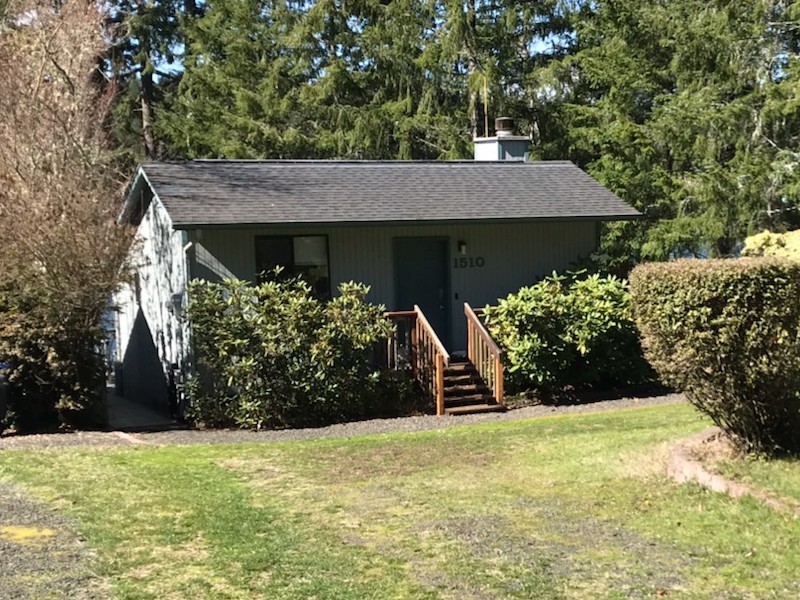
First, let’s recognize that ADUs can be either separate from a single-family home or attached to it. The former are sometimes called DADUs (for detached accessory dwelling units). The key point is that the ADU and the single-family home are built on the same lot. Or in the case of San Diego and San Diego, up to five ADUs can be shoehorned into some frighteningly small parcels. In my case (see photo), we are talking about a detached unit. It’s on Treasure Island in Mason County, Washington.
Second, the more important point is not whether the accessory unit is attached or detached or how many units are allowed on the lot but what “dwelling unit” actually means. Obviously, that can vary depending on your income, age, taste, personal baggage, prior living experience, and family size. A homeless person and Jeff Bezos would have different expectations on whether they could “dwell” there.
Certain minimums need to exist though, including a kitchen (however spartan), bathroom, place to sleep, and a modicum of storage. Separate off-street parking? Not always. Plus security—that is, a way to restrict entry by others and preserve privacy.
I’m not Jeff Bezos, but I’m not homeless either. In addition to the vacation home shown in the photo, I own a home in Bremerton on Mud Bay with three bedrooms, a large kitchen, a laundry room, and other features that most middle-class Americans want. So I have some expectations of what a true “dwelling unit” should include.
Although on paper many people would be happy with my vacation home, they haven’t tried to actually, well, dwell there. In its favor it has a large lot, a ton of privacy, great neighbors, a solid year-round structure, 60 feet of waterfront, and an occasional herd of yard deer. So what’s not to like?
For one thing, the home is constructed on a slope with a half-flight of stairs separating its two levels. Never choose to live in place built that way. You will continuously find yourself on the wrong floor. There are almost 600 square feet of living space, but the layout doesn’t allow for the addition of laundry facilities or a dishwasher without a complete remodel (read teardown).
Try living there long term. As I argued above, the definition of “dwelling unit” is mainly up to the expectations of the person who dwells there.
In my opinion, much as I love it, the ADU I co-own falls a bit short of being a dwelling unit. Plus there’s no main house for it to be detached from or serve as an accessory to. Until there is or until it is remodeled, I’m going to continue to refer to it as an ADU but with a twist—in its case, ADU stands for Almost a Dwelling Unit.
 Mud Bay Blog