
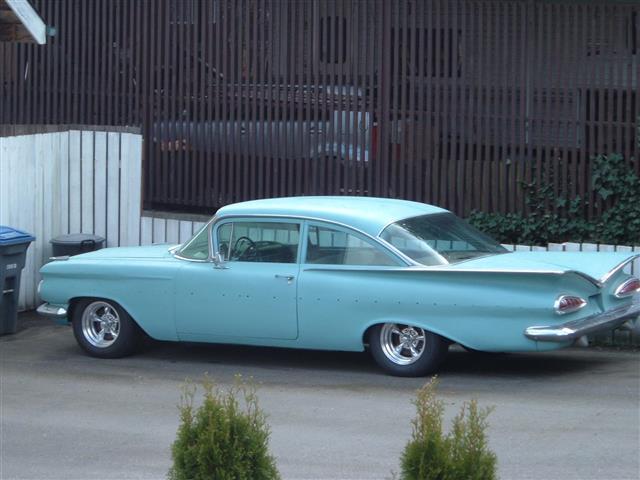
1959 Impala, Bel Air, or Biscayne?
A home on Chico Way occasionally has a collector car in some stage of restoration parked out front. This week it’s a 1959 Chevrolet two-door sedan (see photo). Because the car is missing its badging and side molding, answering the question posed in the picture’s caption took a bit of detective work.
With its batwings, cat eye taillights, and headlight brows, the 1959 Chevrolet is one of the most unusual automotive designs of all time. People seem to like them or hate them with few opinions remaining neutral. Actually, when compared to other cars produced in the final year of the fabulous fifties, the tailfins are somewhat subdued. Chevy’s design was popular enough that year to sell more than 1.4 million cars.
Excluding station wagons and El Caminos, three models of passenger cars were available from Chevrolet in 1959: the low-cost Biscayne, the mid-level Bel Air, and the top-of-the-line Impala. The car in the photo has to be one of those three.
For 1959, Impalas were available in four body styles: convertible, two-door hardtop, four-door hardtop, and four-door sedan. The latter two were new for 1959 as the Impala became a separate model following its 1958 debut as an upscale option in the Bel Air series. It was not sold as a two-door sedan in 1959. This means the feature car cannot be Chevy’s luxury model.
Biscaynes also debuted in 1958. For 1959, three body styles were available: four-door sedan, two-door sedan, and two-door utility sedan (no back seat). So the feature car could be a Biscayne—unless you consider another clue. The side molding was a styling indicator that you were driving a low-cost no-frills Biscayne. It only ran from the headlights to the center of the front door. Because the car in the photo has holes in the sheet metal to accept clips from a full-length molding, it isn’t a Biscayne unless it was modified after leaving the factory.
That leaves the Bel Air. For 1959, Bel Airs were sold as four-door sedans, four-door hardtops, and two-door sedans. Despite being dropped to second place in the model hierarchy, Bel Airs were nicely appointed with several deluxe features such as foam seat covers and a deluxe steering wheel. The side moldings ran full length and had painted inserts. If you look closely, you can see another Bel Air styling clue: front fender ornaments.
Based on its body style, side molding holes, and cool jet-plane ornaments above the headlights, the feature car is almost certainly a Bel Air.
I’m not sure what’s under the hood now or what engine was installed at the factory. The car was on private property so I only got within camera distance of it. If I see it at a car show this year, I will be sure to ask.
I consulted two web sites for details on the 1959 Chevrolet models:
 Mud Bay Blog