

USS Long Beach—hiding in plain sight
The USS Long Beach, the Navy’s first nuclear-powered surface ship, had been quietly moored in Bremerton, Washington, since being deactivated in 1994. Not any more. This week the big cruiser was towed away from its berth at the Inactive Ship Maintenance Facility (see photo), ending any chance for an easy photo op.
Last month I read of the plans this summer to auction the Long Beach for scrap through Government Liquidation, the sales channel for disposing of surplus and scrap assets belonging to the Department of Defense. I should have paid more attention to the auction dates (July 10 through 12). While I felt some urgency, I thought there was plenty of time left for a photo shoot by my friend R.B., an excellent amateur photographer.
On Wednesday morning R.B. called me from the Bremerton ferry as it left for Seattle. “What’s the number of your dad’s ship?” he asked. When I told him CGN-9 (for guided-missile cruiser, nuclear), he replied that a ship with a big 9 on the bow was anchored out in Sinclair Inlet with the bow pointed back toward the shore. “This is going to be easy,” he said. “Tomorrow I will get you all the photos you want. I might not even need my telephoto lens. It’s that close.”
R.B. called me again late that afternoon as his ferry pulled into Bremerton. “Sorry, dude,” he said. “It’s gone. I can see the subs that were moored next to it and an empty berth where it used to be.”
I should explain what he meant by saying “your dad’s ship.” My father, a retired vice admiral, spent most of his Navy career in submarines. After serving in the Pacific during World War II, he joined the nuclear program at just the right time—his reputation, rapport with Admiral Rickover, and a bit of luck led to his selection in 1954 as the commanding officer of the submarine USS Nautilus, the Navy’s first nuclear-powered ship.
With the success of the Nautilus and other submarines, the Navy started building surface ships powered by nuclear reactors. First up was the Long Beach, launched in 1959 and commissioned in 1961. A lot of eyebrows were raised when my dad, a former submarine skipper, was selected as its first CO. I’m understating things here since I was a kid then and don’t have first-hand knowledge of how the surface-ship commanders reacted. There was probably a near mutiny when the command wasn’t awarded to one of their own.
As an interesting coincidence, Dad was born in Long Beach, California.
Although my father was the commanding officer of the Long Beach from 1959 to 1963, he only got to take it out to sea for two of those four years. It was like being the driver for a powerful luxury car that’s always in the shop. A strike at Bethlehem Steel in Quincy, Massachusetts, where the Long Beach was built, caused the ship to be delivered about a year late. During his last year aboard the big cruiser, it was homeported in Philadelphia for a variety of work at the naval shipyard there, including an upgrade to the all-important Terrier and Talos guided missile systems.
To my brothers and sister all this meant was that Dad was home a lot more than in his submarine days. He never said the Long Beach was his favorite command (the Nautilus easily wins that contest), but he was proud of it and took us along for visits as often as his schedule allowed. One of my favorite memories is of visiting his quarters on the ship, which were near the bridge and included a stateroom with a double bed, office, and dining area, where we were served five-star meals by a trio of Filipino stewards. My siblings will remember the chief steward’s specialty dessert—Baked Alaska.
I also remember that Dad was piped aboard when he arrived at the ship. A couple of bells would sound and then a deep amplified voice would announce “Long Beach arriving.” When he left to go home, the procedure was the same except the mysterious voice (probably the officer of the deck) would say “Long Beach departing.” Forewarned the crew could turn to or slack off as the situation dictated. Just kidding on the latter.
I’m biased but I think the Long Beach in its heyday (see photo below) was the best-looking ship in the Navy. After it was deactivated, it was defueled and the entire superstructure was removed at Newport News Shipbuilding in Virginia. Without the missiles and the boxy 8-story command tower, the Long Beach lost its handsome bad-boy look and became just another gray steel hull, albeit one that was 721 feet long.
Even so it was a special hull to me. That’s why I wanted a clear set of photos for my collection and to send to the rest of my family. With its departure from Bremerton, that’s not going to happen. I’ll have to settle for the picture at the beginning of the post, which was taken one evening a few weeks ago from the outermost floating walkway at the downtown Port Orchard marina.
It’s a cliché but if you have plans to connect with an old friend, whether the friend is a human or your dad’s old ship, do it soon. The chance may be gone before you act.
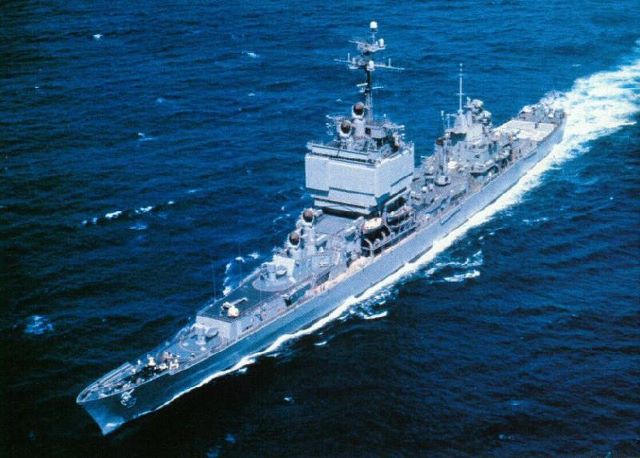
USS Long Beach at sea
 Mud Bay Blog
I’ll never forget the Baked Alaska and Dad’s great sea story with the punch line “But I was born in Long Beach”
Hi there – I have a few photos I could send you. They’re not anything fancy, but let me know.
I served aboard the Long Beach as a nuke working down in engineering in the 70’s. We’ve started up a new website to record the real history of the grey lady and you would be a welcome participant.
https://CGN-9.com