
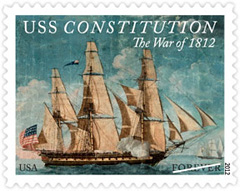
Old Ironsides
To commemorate the 200th anniversary of the beginning of the War of 1812, the USPS will issue a stamp later this year (see illustration). This post covers everything I know, or thought I knew, about the War of 1812. It’s not a long write-up. My knowledge comes from the National Anthem, a decades-old public school education, and the lyrics to the 1959 pop hit by Johnny Horton called “The Battle of New Orleans.”
I may have soaked up a few facts about the War of 1812 from other sources, but I doubt it. I don’t remember ever seeing a movie or reading a book about the War of 1812. No one talks about it. It’s a forgotten war. There’s information on the Internet and in libraries, but why would you read it?
Yesterday I skimmed a Washington Post article about how the Navy plans to use the war’s bicentennial as a springboard for educating the American public about the Navy’s relevance today. The Navy, it seems, has plenty of heroes (Commodore Oliver Hazard Perry), slogans (“Don’t give up the ship.”), victories (the battle of Lake Erie), and souvenirs (the USS Constitution) from the war and wants to leverage them. After all, the War of 1812 was fought over freedom of the seas, a mission that’s still important 200 years later.
But what really caught my eye in the article is that we are observing the bicentennial of a war that few people, including me, know much about. I might have learned of the anniversary when the USS Constitution stamp is issued in August, but that’s far from certain. It’s quite possible that the War of 1812’s bicentennial could have flown under my limited radar all year.
For the record, the USPS is issuing one War of 1812 stamp this year. The Civil War, the darling of historians, gets two stamps in 2012 during the 150th anniversary of its second year. Talk about no respect. When the centennial of the War of 1812 occurred in 1912, no stamps were issued.
I’m not proud of it, but here’s the core dump:
The U.S. won the war (or at least we didn’t lose). I’m going to count this as something I knew even though I reasoned it out rather than recalling it as fact. So far we have only lost one war (Vietnam) unless you count the War on Drugs. The War on Terrorism is ongoing.
Despite its confusing name, the War of 1812 lasted until at least 1814. (Actually it ended in 1815.) From the “Battle of New Orleans”:
In 1814 we took a little trip
Along with Colonel Jackson down the mighty Mississip.
We took a little bacon and we took a little beans
And we caught the bloody British in the town of New Orleans.
Andrew Jackson fought in the War of 1812. Of course, Old Hickory was only a colonel then, but according to Johnny Horton, his troops knew how to improvise:
We fired our cannon ’til the barrel melted down.
So we grabbed an alligator and we fought another round.
We filled his head with cannon balls, and powdered his behind
And when we touched the powder off, the gator lost his mind.
Jackson went on to become our 7th president. Today, he would probably be asked to guest star on the hit TV show “Swamp People.”
The war was against Great Britain, whom we had recently defeated during the Revolutionary War. As a kid studying U.S. history, I remember wondering why we fought another war against the British so soon after winning our independence from them. In truth, this “knowledge” is wrong on a couple of levels. The Revolutionary War ended in 1783, so there was as much time between it and the War of 1812 as there was between Vietnam and the second war with Iraq. Plus the War of 1812 was a threesome that included Canada. That’s right, our Great Northern Neighbor today was under the British Crown then and stabbed us in the back.
Baseball and football games and many other important events depend on the War of 1812. OK, we could probably still figure out how to start the Super Bowl, but the National Anthem wouldn’t have lines like this:
And the rockets’ red glare, the bombs bursting in air,
Gave proof thro’ the night that our flag was still there.
Did they have rockets during the Revolutionary War? Probably not. That’s how I figured that “The Star Spangled Banner” is about the War of 1812. Looking it up: Francis Scott Key wrote the above two lines and the rest of the poem “Defense of Fort McHenry” in 1814. It became the National Anthem in 1931.
During the War of 1812, the British burned much of Washington D.C. to the ground. This is bad behavior, even for wartime, until you look at the bright side. After the war, the United States completely rebuilt the beautiful buildings in our capitol that house our three branches of government, including Congress. However, speaking of Congress, maybe we should challenge the Brits to have another go at us. If they burn Washington D.C. again, Congress won’t be able to get us further into debt for the next few years.
 Mud Bay Blog
Actually, Rod, there is a movie called fittingly enough, The War of 1812. You can read about it here: http://www.imdb.com/title/tt2086938/ You’ll note that one reviewer, who gave it 8/10 stars found it “Both Interesting & Educational” so maybe you’ll want to check it out, or you can watch a 20 minute film form the National Archives on YouTube: http://www.youtube.com/watch?v=WQDDcn1w5z0
Neat. Sounds like a good way to add to my limited store of “facts” about the War of 1812.
I like the way you worked the songs in. Of course I remember those so maybe more people know more about than you think. The beauty of verse.