
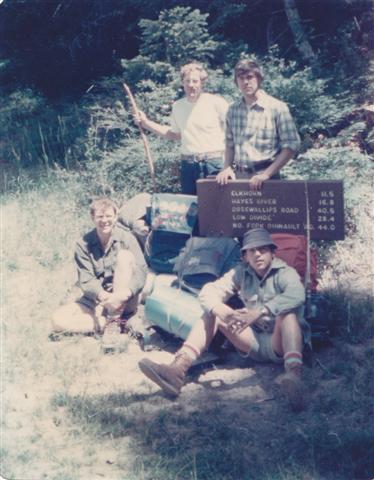
End of the hike---Whiskey Bend
It was 1976, the year of the Bicentennial. I was spending my first full summer in western Washington. J.K., a co-worker at DDL, was an accomplished climber and backpacker. We had both read Robert Woods’s detailed book about the Seattle Press Expedition of 1889-90—the first group to explore the interior of the Olympic Mountains. The Press party crossed the Olympics from north to south, ending up at Lake Quinault.
Although we were inspired by the book, we decided to go the opposite direction. We hiked up the Quinault River, over the Low Divide, and then along the Elwha to Lake Mills, where the Elwha River trail starts, just inside the boundary of the Olympic National Park. Not counting side trips, that’s a 44-mile hike. It took us four days. Because our route bisects the park, it looks impressive on a map.
As reinforcements we invited two guys from out of town. J.K.’s brother flew in from Minnesota. My choice was my then brother-in-law, F.C. He was living in California at the time. To convince him to go I talked up the fishing possibilities (a subject I knew nothing about).
The Press guys were tough. They started their trip in December and spent six months exploring the Elwha and its tributaries. For the first 10 miles they hauled their supplies up the freezing river on a barge. When further progress was impossible, they switched to mules. The reason for a winter start was to get a jump on several other rumored expeditions. After years of being terra incognita, all of a sudden seemingly everyone wanted to explore the interior of the mysterious Olympic Mountains.
We started our trip in late June. Even so there was a foot of snow at the Low Divide—our destination for the first night—and the weather there was mixture of fog and drizzle. I have a photo of a wet miserable group of guys taken near a frozen-over Lake Margaret who were wondering if we should have delayed the trip a month. It would only be a slight exaggeration to say that the Low Divide shelter saved our lives. Without it we couldn’t have camped there and dried out our gear. Loss of some of our food to an aggressive group of rodents at the shelter was critical but not enough of a reason to turn back.
The rest of the trip was woods and water. For three days we followed the Elwha on its trip north toward the Strait of Juan de Fuca. I don’t remember a lot of details from the hike except that it was a long slog. Also that the trail is on the east side of the river and much of the time is a hundred feet or more above it. At night we would camp on one of the Elwha’s many tributaries. We did hike down to see the old homesteading cabin at Hume’s Ranch and the Goblin Gates, a deep canyon where the river flows into a wall of rock and makes a 90-degree turn.
We were hungry and, I thought, totally out of food when we reached Whiskey Bend. But J.K.’s brother, the nicest man you could hope to know, had saved some of his crackers, cheese, and jelly for us to feast on while we waited for our ride home (J.K.’s wife). His wonderful gesture is my fondest memory of the trip.
I have been back to the Elwha River many times since our big hike. If I drive up to see the dam-removal project, I will write another post.
 Mud Bay Blog
I remember that trip – the after effects of it anyway.
This reminds me of the fascination people around here have for John Wesley Powell and his exploration of Glen Canyon before it was filled with water when Lake Powell was created. Apparently, Glen Canyon was one of Utah’s most beautiful canyons and many are still so sad it was filled with water they want to drain Lake Powell so they can see it.