
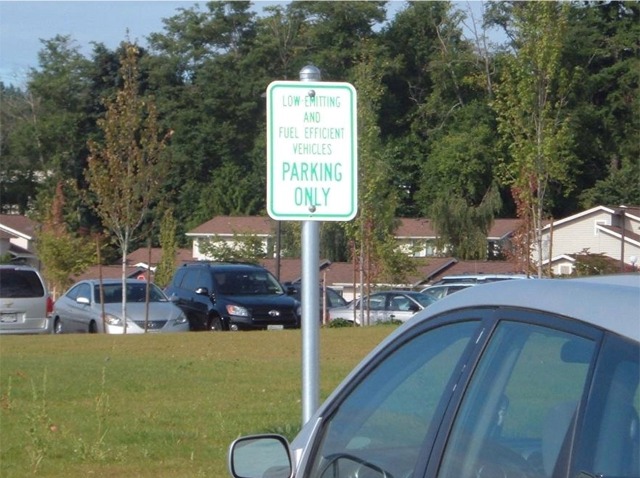
Sorry, trucks don't qualify
On a sunny morning earlier this week, the parking lot at the new YMCA in Silverdale was perhaps one-third full. The occupancy rate in the spots reserved for low emitting and fuel efficient vehicles (LEFEV) was far higher. Only a couple of the thirty or so LEFEV spaces (see photo) were empty. I parked at the far corner of the lot, ate my Burger King breakfast sandwich, and pondered my cynicism.
To begin with there’s the irony of being allowed to park closer to the entrance to a place where you are going for a workout. LEFEV spots permit that. The only closer places are reserved for disabled patrons. Maybe saving a few steps makes a difference if you are lugging a heavy gym bag. But reserved spots seem like a more valuable perquisite for the able bodied when finding any open spot is tough, not when their beneficiaries don’t have to walk as far.
The Silverdale Y has a huge parking lot that will probably be near capacity only when a community event is taking place. At that point will drivers of gas guzzlers honor the sanctity of LEFEV spots and park off campus? Let’s make it November so our infamous rainy weather comes into play. Since the list of qualifying vehicles is almost impossible to memorize, and thus enforce, and there is no listed penalty, I’m betting the LEFEV spots wouldn’t stay open for long.
The day I visited the LEFEV spots were occupied by a mixture of vehicles, including more varieties of hybrids than I knew existed. The common denominator? All of the cars were new and small. There were no trucks in the LEFEV spaces. I mean real trucks, not small SUVs built on a truck chassis that allow automakers to meet the EPA-mandated mpg standards for light trucks even though every model of pickup sold is below the fleet average. Try hauling a load of topsoil with one of those “trucks.”
Because it contributes to my cynicism and sour grapes attitude, I should disclose that I drive a nonqualifying 1999 4-cylinder 2wd Toyota Tacoma pickup truck. It gets decent gas mileage—about 25 mpg overall. Other than my collector car, it is my only vehicle and it fits my lifestyle. When Toyota or another automaker starts building a small truck that gets better gas mileage than mine, I will trade up. Until then I don’t plan to switch to a high mileage small car or SUV.
Curious as to which vehicles qualify I did some research on the Internet. The information is readily available from the EPA and at web sites like Re: Vision Architecture, although I suppose most owners of LEFEVs are already aware of their special status. Perhaps it even influenced their choice of which new car to buy because of a genuine desire to pollute less. A federal tax deduction, if applicable, makes the buying decision that much sweeter. If you don’t know if your vehicle qualifies, likely it doesn’t. As a taxpayer, your role then is to subsidize LEFEV purchases, hope the subsidies are still around when you go car shopping, and stay out of parking places you might have helped pay for.
From what I have read, installing LEFEV signs is a sure way for a building project to gain additional points toward meeting LEED (leadership in energy and environmental design) standards. This can be critical if the developer needs to qualify for a low impact development grant (like the Silverdale YMCA did) as part of a financing plan. I’m for building green but only if a project pencils out on its own not because taxpayers footed part of the bill.
I’m also in favor of consumer information. In my view the EPA is doing a great job providing facts and figures on how new cars perform on pollution and fuel economy tests. (I think automakers game the numbers to meet fleet mpg standards, although that’s not the issue here.) But that’s where I would end things. Make information widely available to help people make an informed buying decision, but stay away from picking winners and losers through tax incentives.
Back to the question posed by the post’s title. Like many issues that divide us, there’s no pat answer. The signs certainly help LEFEV owners. If nothing else they probably feel good about themselves every time they park in an LEFEV place. Maybe the signs even tilt buying decisions toward increasing the percentage of LEFEVs on the road. That’s a good thing, but it should happen because people are informed and want to do the right thing on its own merits not because of gimmicks.
On the down side the signs lead to a certain amount of elitism and cynicism. Those are bad things. They aren’t conducive to a countrywide buy-in on the critical need to actually use less energy and reduce pollution. I’m being idealistic and I don’t know how to achieve this consensus, but that’s what I think it is going to take.
 Mud Bay Blog
Here in Japan people buy fuel efficient vehicles because fuel is really expensive.
i haven’t noticed any here. I don’t think that should help qualify for LEED.