
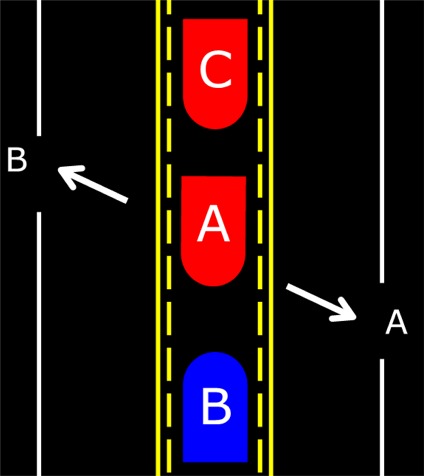
Which vehicle is next after A?
Today’s traffic question is concerned with etiquette in a center turning lane, sometimes called a suicide lane. In the diagram shown above, vehicle A, headed for destination A, will be the first to turn. Once the traffic clears and A makes a left turn to its destination, which vehicle should be the next—B or C? Should C yield to B so that B can pull forward in the center lane in order to turn left to destination B? Or should C, also bound for destination A, take A’s old spot, thus blocking B, and wait for its chance to turn? Assume that all three vehicles are fairly new, carry collision insurance, and none has an intimidating Dodge Ram-style front grille.
I don’t know the answer. Today, on Silverdale Way, I was in vehicle B. C did not yield to me. Neither did D (not shown but going the same direction as C). Only after D turned was I able to pull forward and make my turn. The traffic in the outside lanes was heavy enough to cause a wait between turns and thus give me time to ponder the question. When I got home, I checked the Washington Driver’s License manual. It reminded me that no one has the right-of-way. Instead in a number of situations, for example when vehicles are in an intersection or when an emergency vehicle approaches, the law specifies who needs to yield the right-of-way. Center turning lanes aren’t mentioned, and the rules of yielding to the car on the right or already in the intersection don’t seem to cover the situation.
 Mud Bay Blog
Could this be a puzzler for car talk? Perhaps you should write to the DMV of several states to see what they say. Good luck getting an answer meanwhile I think the answer is B. C should yield to B because C is in line behind A.