
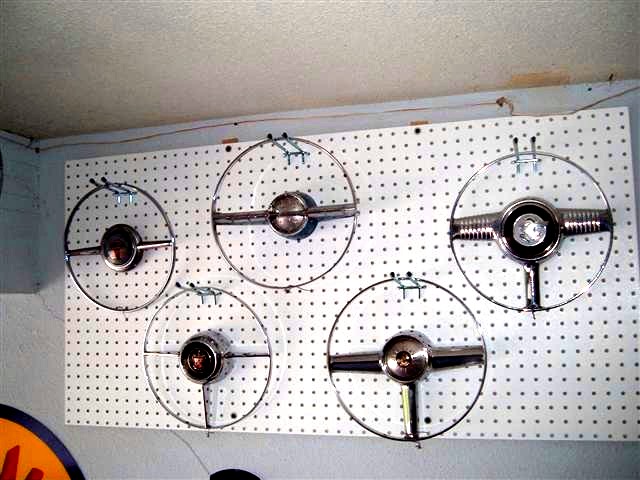
Ford, Oldsmobile, Pontiac, De Soto, Buick horn rings (clockwise from upper left)
Automobile horn rings date back to the days of heavy exterior chrome, glitzy dashboards, and designers who were more concerned with looks than safety. The rings were functional as well as eye catching—press anywhere on the ring or its center emblem and the slowpoke in front of you instantly knew it was time to get moving. My small collection of horn rings has been in storage since I moved a couple of years ago. Recently I mounted them on a pegboard panel in the garage (see photo).
There are hundreds of listings for horn rings on eBay. They are also available at swap meets and shops that sell automobile memorabilia. Of course much of the market is for people restoring collector cars as a vintage steering wheel doesn’t look right if the horn ring is broken or missing. I don’t know if horn rings by themselves are collectible, although I suspect they are. I can’t be the only one collecting them.
The word “ring” is a bit of a misnomer as many horn rings aren’t round. A more common shape—particularly on a lot of Ford products—is a half circle. In the 1930’s many cars omitted the ring altogether and relied on just a horn button. Whatever the design, horn ring is a good umbrella term for all of them. I only collect round ones no matter how attractive the center emblem on a half-circle horn ring might be. The emblems are used to display the automaker’s marquee or crest or the name of a luxury feature like power steering (back when it was less common). On some Oldsmobiles the emblem was replaced with a steering-wheel-mounted self-winding clock.
The web site Identifying Instrument Panels, Clusters & Gauges is a helpful guide for determining the year and make of many horn rings. It’s difficult to summarize an entire decade of automotive dashboard design in a few words, but the web site offers general guidelines: art deco (1930’s), continuation of the streamlined look (1940’s), jet aircraft and rocket look (1950’s), and simpler designs with subdued colors (1960’s). They also include a number of close-up photos.
Any of the horn rings in my collection would look as out of place in my 1999 Toyota Tacoma as its steering wheel would in a 1950’s truck. There would also be a problem trying to integrate a horn ring with a driver’s side airbag. So it’s probably just as well that horn rings went the way of bias-ply tires. One thing their disappearance hasn’t eliminated is use of the horn itself. Cut someone off in traffic and you will hear about it.
 Mud Bay Blog
What years are yours?
1948 Ford, 1956 Olds, 1952 Buick, 1948 Pontiac, not sure on the De Soto