
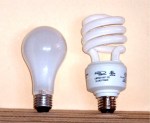
Regressing from a perfect shape?
Compact fluorescent lights (CFLs) can help reduce your electric bill. According to the Energy Star web site, CFLs need more energy when they are first turned on, but once the electricity starts moving, they use about 75 percent less energy than incandescent bulbs. They also last up to 10 times longer and can thus replay their higher initial cost several times over their lifetime. A single Energy Star-qualified CFL can save an estimated $30 in energy costs. So when the light bulb in the 3-way table lamp I use for reading burnt out last week, I decided to replace it with a 3-way CFL, assuming such products exist. They do, but my great idea went nowhere as the one I bought was expensive and wouldn’t fit in the lamp.
Because CFLs produce light differently than incandescent bulbs, they are a different shape and size. The CFL I bought is about 3/4 of an inch longer than the bulb it replaced. In many table lamps, that difference alone makes it too tall to fit within the metal harp that surrounds the light. The real problem though is the wide ballast at the base of a 3-way CFL, needed to regulate the current flowing through the spiral tube at the top. The ballast makes the overall shape cylindrical instead of, well, light-bulb shaped. Since the harp tapers at the bottom where it joins the lamp neck, there’s no way to fit a 3-way CFL inside. Remove the harp and there’s no support point for the shade.
Rite-Aid, the first store I went to, didn’t carry 3-way CFLs. McLendon’s, a local hardware store, had them but they seemed pricey at $10 each. After researching CFLs on the Internet, I went to Lowe’s, which stocks an Energy Star-compliant 3-way CFL by Bright Effects. The soft white light version, priced at $8.48, is rated at 50/100/150W while using only an energy-saving 12/19/28W. Life expectancy at 6000 hours is far superior to fragile short-lived 3-way incandescents (has anyone every gotten 1200 hours out of one?). The clincher came when I noticed two plastic extenders included in the package designed to enlarge the width and height of the harp. I bought one figuring I could make it work somewhere in my house.
Single-wattage CFLs are useful in many applications, for example, in porch lights or overhead lights in the cellar. They quickly pay for themselves and are environmentally friendly assuming the mercury gas they contain is disposed of properly. Sales have skyrocketed due to rebates by government and power companies. The 3-way versions aren’t necessarily more of a good thing though. I found out the hard way why they aren’t enjoying the same success. The cheap plastic extenders, thoughtfully included by Bright Effects, didn’t match the harps in any of my table lamps and broke when I tried to force fit them. Even my 3-way floor lamp, which has a larger harp than my table lamps, won’t accommodate the CFL.
Next time I’m at Seattle Lighting, I’ll ask if they carry table lamps designed for 3-way CFLs. Until then, to support my reading habit, I’m stuck buying 3-way incandescent bulbs that seem to burn out every couple of months.
 Mud Bay Blog
I didn’t know that they made 3-way ones. Do they only came in 50/100/150? I think you should have said more about the
mercury gas and disposal.