
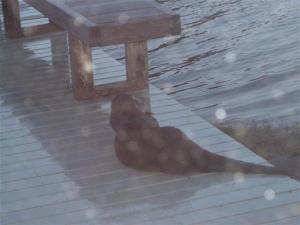
Otter view
Mud Bay is a body of salt water. Washington state has a large population of sea otters (around 1000 by one estimate). So the otter that sacked out on my deck one winter morning last year (see photo) was a sea otter, right? Wrong. “What you had was a river otter,” said my cousin J.A., retired curator of marine mammals at Sea World in San Diego. His wife, a former animal trainer at Sea World and the San Diego Zoo, agreed. The clincher was the otter’s choice for a napping place. Members of the weasel family, both river otters (Lontra canadensis) and sea otters (Enhydra lutris) move about easily in an aquatic environment, but only the river otter is equally versatile on land. It would be extremely difficult for a sea otter to haul itself up on my deck. Sort of like the difference between a seal and a sea lion.
The name “river otter” is a bit of a misnomer. I can’t improve on Wikipedia’s helpful attempt to clear up the confusion: “Although commonly called a ‘river otter,’ the name can be misleading, as the animals inhabit marine as well as freshwater environments.” While most river otters I have seen have been the size of house cats, this one does fit in the upper end of the size range for its species (11 to 30 pounds and up to 42 inches in length). Had it been a sea otter, it would have been a small one, as males range from 49 to 99 pounds and females weigh between 30 and 73 pounds. After a brief rest the otter moved on, possibly to hunt for fish, mollusks, or crustaceans in Dyes Inlet. From my safe vantage point inside the house, the sleek visitor didn’t appear to have missed too many meals.
 Mud Bay Blog
Cool picture. I didn’t know you had an otter on deck. Or maybe you told me and I forgot. Do you see them very much in the water if not on your deck? Do sea otter ever come into Mud Bay? What did the cat think?