Monthly Archives: May 2009

An Accidental Cat Perch

Nap Time

Nap Time


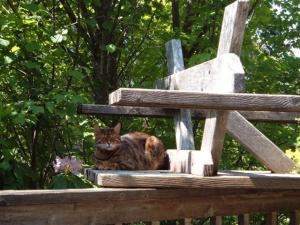
The cat perch at Treasure Island (see photo) wasn’t created by design. Maybe that’s why the cat likes it so much. It’s shady, perfect for napping, and the thick rough cedar planks do double duty as a giant scratching pad—for his claws and his back. Perched above the deck his view is both scenic and strategic. Plus he can retreat to the far corner where I can’t reach him, so he goes there when he wants to stay outside awhile longer. I don’t mind because at least I know where he is.

K’s younger brother gave us the picnic table years ago, not long after we bought the vacation place at Treasure Island. It’s a massive thing, stable as an aircraft carrier, and seemingly about as heavy if you try to move it by yourself. Every couple of years when I would seal the deck boards, it was always a major undertaking to remove the table from the work area. Last time, with the help of a large strong friend, I flipped the table up onto a corner of the railing to get it out of the way. The contented hours that the cat spends atop the table are a strong vote for leaving it there permanently. As for us, now we use a different smaller picnic table that K’s dad made.


So Long, Panda Inn

Panda Inn Sign

Panda Inn Sign


This isn’t news. The Kitsap Sun reported a couple of weeks ago that the Panda Inn was about to close after 14 years at its location on Kitsap Way in West Bremerton. (The East Bremerton Panda Inn will remain open.) The restaurant’s passing didn’t fully register with me though until I noticed the “restaurant for sale” sign during yesterday’s bike ride (see photo).
Continue reading

Trike Ban

How does an organization like the San Diego Wild Animal Park with an experienced public relations staff err on the question of allowing adult tricycles on their trails? My take is that they must not understand what an adult tricycle means to someone who has difficulty walking. I don’t have difficulty walking, but the co-owner of my vacation place at Treasure Island does. Last year several of us chipped in to get her a shiny blue adult tricycle for her birthday. Having purchased a trike and having seen the effect the increased mobility it provides has on her, I think the Wild Animal Park was dead wrong in their decision last month.
Continue reading

Pittsboro’s Finest

Pittsboro storefront

Pittsboro storefront


I just bought a painting—a watercolor titled “Pittsboro’s Finest.” The artist is one of my cousins, G.K. of Sandy, UT. She and her sister, who also paints, plus their husbands, were in San Diego last weekend to attend the 2009 Western Federation Art Show. I flew down from Seattle to visit my dad and sister in Del Mar and to attend the family reunion triggered by their trip. My cousin had some note cards displaying renditions of her work. After looking through them, I decided, on the spot, to buy one of her watercolors.
Continue reading

Otter on Deck

Otter view

Otter view


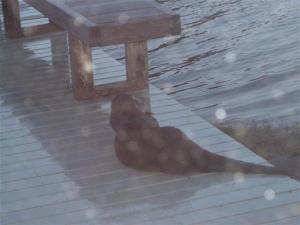
Mud Bay is a body of salt water. Washington state has a large population of sea otters (around 1000 by one estimate). So the otter that sacked out on my deck one winter morning last year (see photo) was a sea otter, right? Wrong. “What you had was a river otter,” said my cousin J.A., retired curator of marine mammals at Sea World in San Diego. His wife, a former animal trainer at Sea World and the San Diego Zoo, agreed. The clincher was the otter’s choice for a napping place. Members of the weasel family, both river otters (Lontra canadensis) and sea otters (Enhydra lutris) move about easily in an aquatic environment, but only the river otter is equally versatile on land. It would be extremely difficult for a sea otter to haul itself up on my deck. Sort of like the difference between a seal and a sea lion.

The name “river otter” is a bit of a misnomer. I can’t improve on Wikipedia’s helpful attempt to clear up the confusion: “Although commonly called a ‘river otter,’ the name can be misleading, as the animals inhabit marine as well as freshwater environments.” While most river otters I have seen have been the size of house cats, this one does fit in the upper end of the size range for its species (11 to 30 pounds and up to 42 inches in length). Had it been a sea otter, it would have been a small one, as males range from 49 to 99 pounds and females weigh between 30 and 73 pounds. After a brief rest the otter moved on, possibly to hunt for fish, mollusks, or crustaceans in Dyes Inlet. From my safe vantage point inside the house, the sleek visitor didn’t appear to have missed too many meals.