
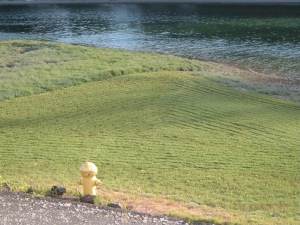
Just Mowed Pickleweed
Pickleweed (Salicornia virginica) is the dominant plant growing along the shore at the mouth of Mud Bay. A low-growing succulent, pickleweed is found in the intertidal zone, meaning it is completely under water some of the time. Thus pickleweed is classified as a halophyte, a type of plant specially adapted for life in salt water. When the roots take up salt water, the plant’s cells filter out the salt and move it to the tips of the leaves. This process allows the roots and stem to remain salt-free and to grow new leaves when the old ones cannot hold any more salt and die.
One web site I consulted said that pickleweed gets its name from the resemblance of its leaves to tiny thin pickles and its salty taste. Another described the leaves as looking like chubby little fingers. Whatever. The most interesting factoid though was that the long-ignored plant is now being being farmed and sold as “sea asparagas.”
Although he likely didn’t have farming in mind, years ago the previous owner of my house decided that the pickleweed on his property needed some human intervention. At low tide he would fire up his lawnmower and give it a trim. I’ll own up to continuing the practice in the couple of years I have owned the house. The property has no other “lawn” to speak of and I likely just miss the yard work I used to do at my old house. The photo above shows a side-by-side comparison of mowed and natural pickleweed. U.S. Open golf officials, no doubt, would like to be able to grow rough like the latter.
Mowing aside, there’s not much I can do to change Mud Bay’s intertidal zone. It’s human nature to try to control and beautify nature, replacing natural vegetation and land contours with lawns, parks, ball fields, and other landscaping. Sure we require developers to leave open space and natural areas because of our now enlightened land use policies, but those areas can be tamed. That isn’t so in nature’s ultimate greenbelt—the shores of Mud Bay (or any salt water). I couldn’t have a rose garden out past the small bulkhead that marks the high tide mark any more than I could live without shelter. I can accept that, although I may keep mowing the pickleweed until the mower completely rusts out.
 Mud Bay Blog
I checked a book written by a friend of mine entitled “Native Plants Torrey Pines State Reserve & Nearby San Diego Locations” Our Pickleweed is also Fenus Salicornia virginia. It is Family Chenopodiaceae or Goosefoot family another common name for it is Glasswort.