
Monthly Archives: March 2009

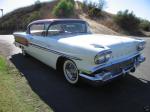
1958 Pontiac

1958 Pontiac Catalina

1958 Pontiac Catalina

It’s spring, the weather last Sunday was great, April starts tomorrow. Definitely time to start thinking about collector cars. I’m hoping for another glimpse soon of the gorgeous black 1958 Pontiac two-door I first saw at Silverdale Transmission a few years ago. Since then there have been enough sightings of the black beauty on Rocky Point Road to conclude that it lives nearby. I have looked for it a few times on my bike rides, but given Rocky Point’s many long driveways and steep terrain, I haven’t had any luck so far. Plus common sense says the pristine Pontiac is tucked away safely inside a garage, making the task that much harder. Even my friend Willy, who seems to know just about everyone in the neighborhood, can’t help me find it.
Continue reading
A Connection to Trails End Lake

A horrific crime that occurred in late February at Trails End Lake in Mason County has a connection to Mud Bay. The story received extensive coverage in the Kitsap Sun and on Seattle TV stations. To summarize, a 46-year-old man beat a woman severely in her home with a chair and cane. Although she was bound with duct tape and bloody, she managed to escape and run to a neighbor’s house. The neighbors called 911 and sheltered the woman until sheriff’s deputies and medics arrived. Her injuries were serious enough to require an airlift to Harborview Medical Center in Seattle. The Kitsap Sun described the neighbors, the Goldbergs, as true heroes for opening their home to the woman so she could escape her attacker. The man returned to her home, where he died in a fire he set after a standoff with a sheriff’s SWAT team.
Continue reading

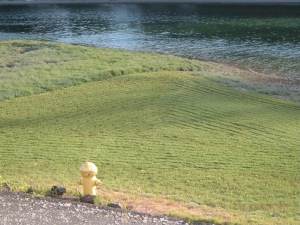
Pickleweed

Just Mowed Pickleweed

Just Mowed Pickleweed

Pickleweed (Salicornia virginica) is the dominant plant growing along the shore at the mouth of Mud Bay. A low-growing succulent, pickleweed is found in the intertidal zone, meaning it is completely under water some of the time. Thus pickleweed is classified as a halophyte, a type of plant specially adapted for life in salt water. When the roots take up salt water, the plant’s cells filter out the salt and move it to the tips of the leaves. This process allows the roots and stem to remain salt-free and to grow new leaves when the old ones cannot hold any more salt and die.
Continue reading

A Great Tides Web Site

If you notice the tides a lot like I do, there are instances when you want to know the official times and measurements for the day’s tides. It’s not enough to look out the window and think “that’s a really high tide” or “looks like at least a minus two.” Of course it is easy enough to buy a tides booklet like Dot’s Fishing Guide at a hardware or sporting-goods store. But Dot’s is limited in the number of tides tables it includes and they always seem to require both a time and measurement correction for your location.

Years ago I stumbled on a great online resource for nationwide information on tides. For my state alone (Washington), it lists 166 locations, including one close enough to Mud Bay that no corrections are needed: Tracyton Dyes Inlet. The web site is easy to use and has never been offline when I have tried it. You can get the tides (and moon data) for up to 14 days at time—present, past, or future. If you need a longer interval, copy and paste the first fortnight into your word processor, change the start date, and click “Get Tides” again. Kudos to the good folks who provide this useful web site:

www.saltwatertides.com

The Old Boat

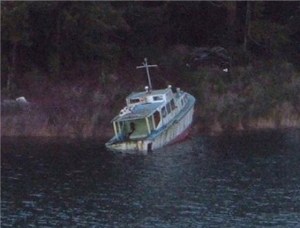
Old Boat at High Tide

Old Boat at High Tide

No one to my knowledge has ever reported or complained publicly about the old boat beached near the mouth of Mud Bay. Nose to the shore, canted to one side, it was abandoned years ago, positioned precisely so the highest tides gently wash the stern but never threaten to refloat it entirely. My home is on Rocky Point on the east side of Mud Bay, directly across from the boat—about 150 yards away as the seagull flies. Each morning, at first light, I look up from my coffee and computer for a boat check. Yep, still there.

It’s an old wood-hulled craft, perhaps a Monk, 30-plus feet long with a full-length superstructure topped by a small pilot house. The remaining paint attests to a red bottom, white sides, a light blue deck, and a mostly white cabin. The stern deck, where you might stand to fish, is covered with a wooden roof. A four-foot cross that used to bear the running lights pokes up from the pilot house. Several horns are mounted on the superstructure and serve as a reminder that the big vessel was used to getting the right of way. If the name was ever painted on the stern, it was removed long ago. Since we seem to be stuck with the old derelict, one of these mornings I’m going to think of a name for it.